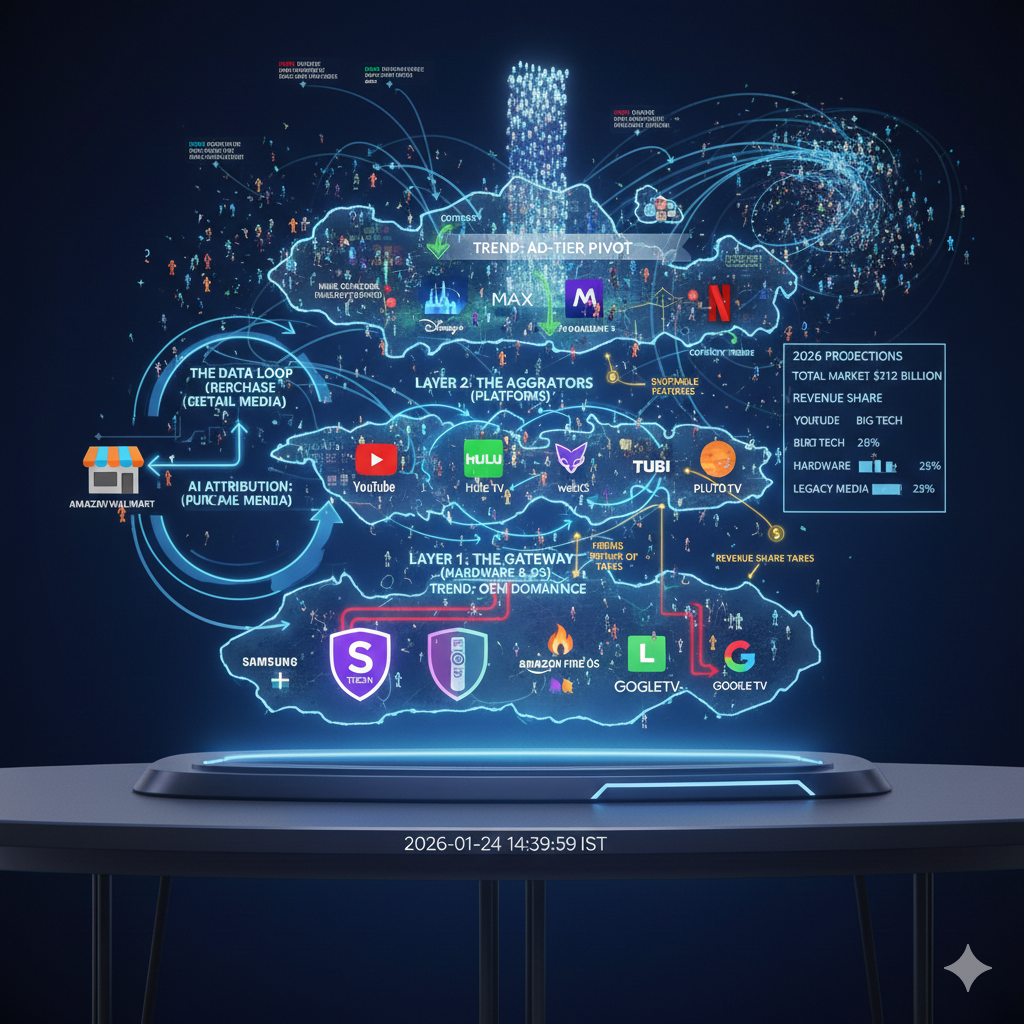
The vision that defined once what separated our screens is blurring. What we watch, where we watch it, and who creates it — these distinctions are starting to dissolve, and fade away.
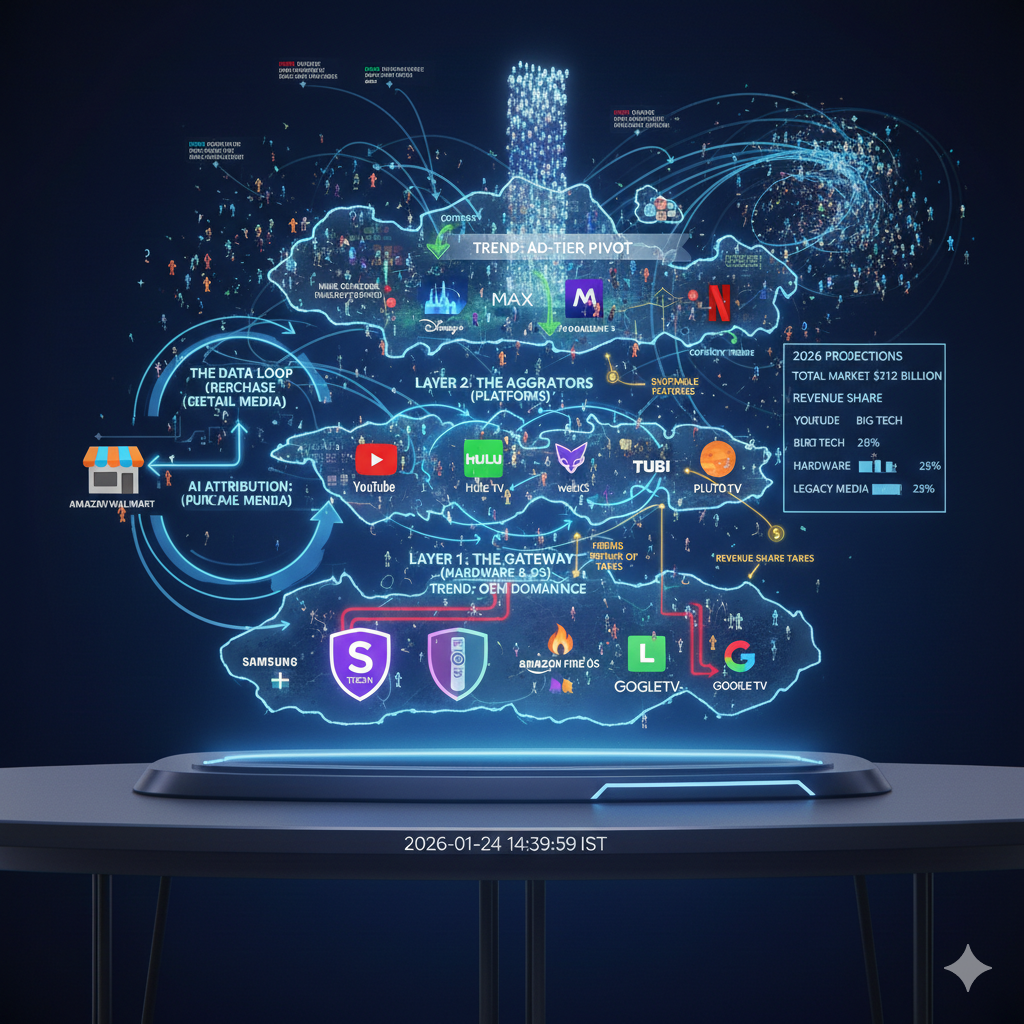
The Screen Convergence Is Here
For years, there has been chatter about the “second screen experience”: checking your phone while watching TV. That framing now feels somewhat outdated. The reality is more radical: there is no second screen, there’s content, flowing seamlessly across and in parallel to whatever gadget that you might happen to use.
YouTube understood this before anyone else did. When smart TVs emerged in the early 2010s, YouTube was there on day one, not as an afterthought but as a cornerstone app. Today, YouTube accounts for nearly 10% of all television viewing in the United States, more than any individual cable network, and reaches more young (and not so young) adults on connected TVs (i.e smart TVs) than any old media network during primetime.
The New Entrants Smell Blood
The connected TV (CTV) market is experiencing explosive growth. eMarketer projects that CTV ad spending will reach $33.3 billion in 2025, up from just $9 billion in 2020. That’s a four-fold increase in five years. When money flies that fast, everyone wants in.
Substack’s recent launch of a TV app is exact example case. Here’s a platform built for writers, for newsletters, for the kind of thoughtful long-form content that seems antithetical to lean-back television viewing. Yet they’re making the leap — and it makes perfect sense.
Substack creators aren’t YouTubers in the traditional sense: they’re not producing daily vlogs, products unboxing videos or pranks. They’re commentators, analysts, educators — people like Matt Yglesias discussing policy, or Heather Cox Richardson unpacking American history. Their video content tends toward the conversational, the analytical, the deeply researched. Less MrBeast, more Charlie Rose. Less meme entertainment, more Video articles and documentaries.
Roku blazed this trail years ago with The Roku Channel, which has grown to reach an estimated 88 million households. They recognized something fundamental: when you own the platform, you don’t need to rely solely on others’ content. You can become the content creator yourself.
The Incumbents Are Scrambling
The traditional media giants are responding with varying degrees of success. Disney went aggressive with Disney+, leveraging nearly a century of high value IP, purchasing more (with Star Wars in particular) Paramount followed suit. Both are hemorrhaging money in the process — Disney+ alone lost $1.5 billion in a single quarter in 2023 — but they’re playing the long game, betting that subscription revenue and brand loyalty will eventually justify the investment. AppleTV and Amazon Prime video, are also pushing hard on content and matching hardware.
Others lagged behind and lost. Warner Bros. Discovery, formed from one of the most significant media mergers in recent history, are now in the process of being steadily devoured by Netflix. HBO Max became Max, shed content, raised prices, and watched subscribers flee.
As core necessity as it is, content isn’t the moat these companies thought it was.
AI Changes Everything (Again)
The barriers to content creation are collapsing at a pace that would have seemed impossible just two years ago. AI tools are lowering the threshold for both writing and video production to practically nothing. A thoughtful analyst with a good microphone and a $20/month AI subscription can now produce video content that looks professionally edited. A writer with Claude or ChatGPT can script, storyboard, and plan an entire series in an afternoon (or two).
Substack’s announcement that it’s entering the AI-assisted video creation space isn’t surprising — it’s inevitable. When your platform is built on empowering individual creators, and the cost of creation drops dramatically, you expand what creation means.
Follow the Money
Connected TV advertising is among the fastest-growing channels in the entire advertising ecosystem, with year-over-year growth rates hovering around 20–25%. That’s just BIG.
Traditional cable and broadcast are watching ad dollars evaporate. Linear TV ad spending declined by 8% in 2023, while CTV surged. The reason is simple: precision. When Procter & Gamble buys an ad during Sunday Night Football, they’re paying for millions of impressions they don’t want — people who will never buy their product, who’ve already bought it, who are outside their target demographic entirely.
On CTV platforms, advertisers can target with surgical precision. Age, location, viewing habits, purchase history, even which room of the house you’re watching from. The ROI isn’t even comparable. Money doesn’t walk away from linear TV toward CTV — it runs to it.
Sports: The Last Domino
Sports, long considered the impregnable fortress keeping cable subscriptions alive, is already following this path. Apple bought MLS streaming rights. Amazon owns Thursday Night Football. YouTube TV has become one of the largest carriers of Sunday NFL Ticket.
The user experience is evolving beyond just watching the game. Real-time stats overlays, multi-angle viewing, integrated betting, social commentary running alongside the action — these aren’t future features, they’re current reality. The NBA League Pass app lets you watch four games simultaneously while tracking your fantasy team and chatting with friends. Traditional broadcasts feel archaic by comparison.
The Market Is Still Forming
Like many other markets in a process of disruption, we’re in the midst of instability. Unlike previous media transitions, broadcast to cable, cable to satellite, this one has no clear end. Previous cycles required high capital investment, few players, clear demand and hence quick prediction to a new equilibrium.
Now we still don’t have any final form emerging, no consolidation on the horizon that will settle things into a new steady state.
Netflix seemed (and still seems) like the winner, until Disney+ launched. Disney+ seemed unstoppable, until it started losing money and subscribers. YouTube dominates watch time, but doesn’t capture premium subscription revenue at the same scale. Roku owns the platform but is still low on content. Smaller and more diverse tv apps are emerging, some of legacy media, some of web services looking to expand. Most recent is Substack
The boundaries will keep blurring. The web won’t just spill into TV, it will become indistinguishable from it. The question isn’t whether this convergence will happen. The question is who will still be standing when the dust settles, and whether any of them will look like the companies we know today.
The smart money says they won’t.
More on Roku
More on Netflix
Continue reading: The Great Unbundling: How the Web Is Devouring Television